What Is a Colloidal Mill?
The machine is designed for easy homogenization, emulsification, dispersion, mixing, etc. A colloidal mill is used for the processing of highly viscous to liquid products in various applications. The principal works on the stator/rotor. The product is fed to the operating area of the rotor, which rotates at a high speed of approximately. 2800rpm, and the product is processed by high shear pressure & friction between stator and rotor. Due to this, the product is exposed to intensive vibrations which exert their force on it by means of pressing & releasing actions. The process for the product is continuous, and it can be recirculated if required. The unit can be used for small, medium, and large-scale production.
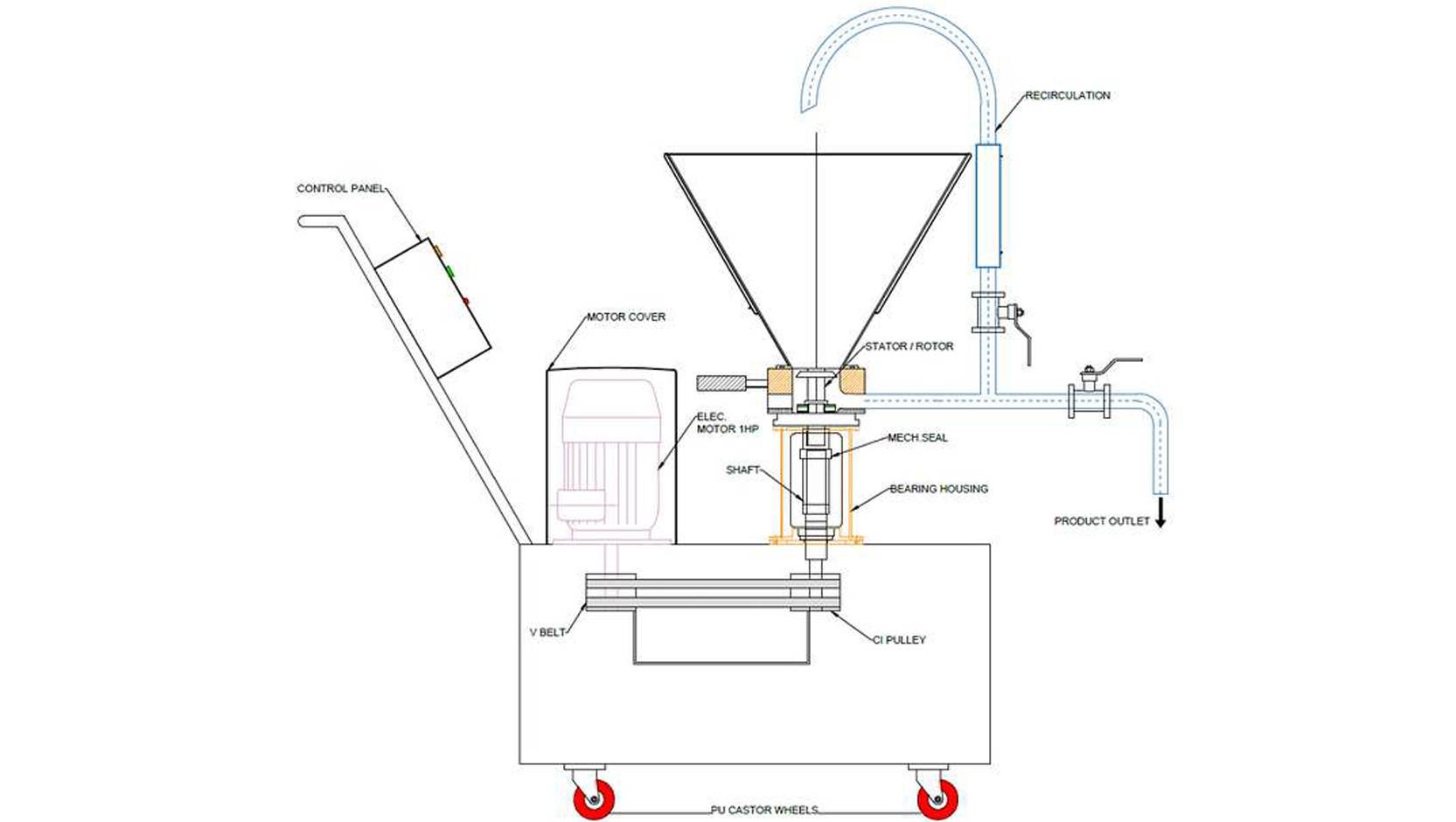
Colloidal Mill Diagram:
To clearly understand how a colloidal mill operates, it is helpful to study its basic structure in detail. The following diagram explains the main components of a colloidal mill, showing how each part works together within the system. By looking closely at these individual elements and their specific functions, we gain a clearer understanding of how the mill achieves its primary purpose, reducing particle size through high-speed mechanical shearing and creating stable, consistent dispersions or emulsions.
Understanding the Colloidal Mill: Why It’s Critical for Your Process
Imagine a skincare or pharmaceutical lab in Mumbai or India. You are formulating a rich cream, a smooth lotion, or a therapeutic suspension. Active ingredients, oils, and the water phase must blend into a consistent, stable, and repeatable mixture. A colloidal mill makes this possible by creating strong shear forces that break down and evenly scatter particles and droplets, turning rough mixtures into smooth, stable emulsions.
Using a rotor–stator system, the mill pushes the product through an accurately controlled gap, exposing it to high-speed shear and friction. This greatly reduces particle size, sometimes to the micron level, and improves the stability and shelf life of your formulations.