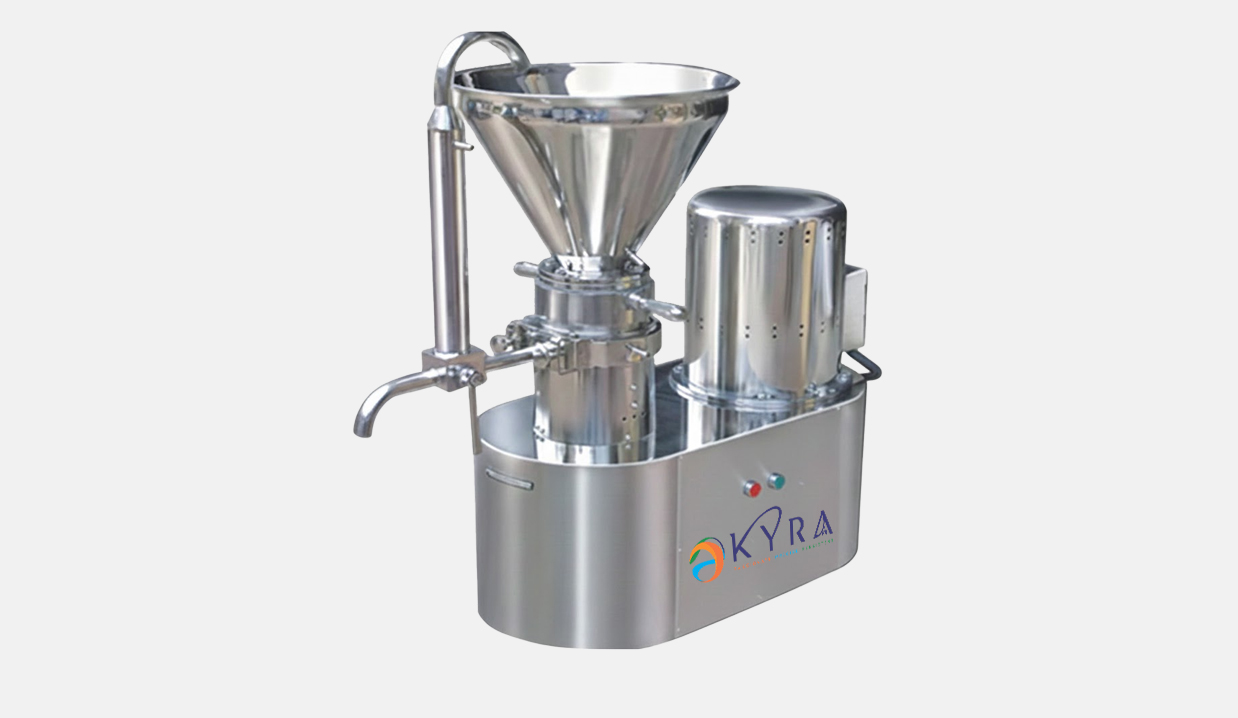
In the world of modern manufacturing and processing, achieving a consistent, smooth, and unchanging mixture is critical. Whether it’s in pharmaceuticals, food, cosmetics, or chemical industries, the demand for accurate particle size reduction and mixing is ever-growing. That’s where the colloidal mill comes into play, a mechanical device designed to deliver excellently ground products with extraordinary regularity.
At Kyra International, a Top Manufacturer in Mumbai, we take pride in designing and engineering high-performance colloidal mills that meet the toughest industrial standards. Our machines are built to optimize productivity, minimize waste, and ensure consistent product quality across batches, setting a new standard for processing excellence.
The Story Behind the Colloidal Mill: From Concept to Accuracy
Imagine a product that needs to blend oil and water into a stable mixture, a near-impossible performance without the right equipment. Historically, traditional mixers struggled to achieve this level of fineness. But with the evolution of high-shear mixing technology, the colloidal mill emerged as a revolutionary solution.
This machine works on the principle of shearing, grinding, and high-speed mixing, creating refined blends and suspensions that increase product performance. Over time, the colloidal mill became a necessary tool across multiple industries, from producing creams and ointments in pharmaceuticals to refining sauces, emulsions, and paste in food processing plants.
What is a Colloidal Mill?
A colloidal mill is a high-shear mixer used for reducing the particle size of a solid suspended in a liquid, ensuring regular distribution and stability. It is primarily used to produce fine mixtures and unchanging suspensions where droplet sizes range from 1 to 5 microns.
In simpler terms, it’s like a precision blender that breaks down particles until they smoothly merge into one consistent, stable mixture
Principle of Colloidal Mill
The working of a colloidal mill is based on the principle of rotor-stator interaction. The rotor rotates at a very high speed, creating high shearing forces that break down the particles between the rotor and stator.
As the mixture passes through the narrow gap, it experiences shear, impact, and turbulence, resulting in a refined, stable blend. The closer the gap and the faster the rotor speed, the finer the output.
Key Principle in Short:
The colloidal mill works on the principle of shear force, which reduces particle size by subjecting the material to highly mechanical mixing between a fast-moving rotor and a stationary stator.
Construction of a Colloidal Mill
A colloidal mill is designed with accurate and hardness to handle high-viscosity materials and continuous operations. The key components include:
-
Hopper:
Where the feed material is introduced into the mill.
-
Rotor and Stator Assembly:
The rotor rotates at high speed while the stator remains stationary. The small gap between them is where the shearing action occurs.
-
Adjustment Mechanism:
Allows precise control over the gap between the rotor and stator to achieve the desired particle size.
-
Motor:
Drives the rotor, typically operating around 2800 RPM depending on the application.
-
Cooling System:
High-speed friction generates heat, so an efficient cooling jacket maintains the required operating temperature.
-
Outlet:
The processed material exits through this port, ready for further processing or packaging.
Colloidal Mill Diagram
To clearly understand how a colloidal mill operates, let’s take a closer look at its basic structure. The following diagram explains the main components of a colloidal mill and their functions.
Working Process of a Colloidal Mill
- The material to be processed is fed into the hopper.
- It passes through the narrow gap between the rotor and stator.
- Due to high shear forces, the solid particles or droplets are broken down into finer particles.
- The processed material emerges as a uniform blending or suspension, ready for use or further processing.
Applications of Colloidal Mill
The colloidal mill finds applications across a wide range of industries:
-
Pharmaceuticals:
Preparation of creams, ointments, suspensions, and syrups.
-
Food Industry:
Production of sauces, mayonnaise, salad dressings, chocolate, and flavour mixtures.
-
Cosmetics:
Formulation of lotions, gels, and creams.
-
Chemicals & Paints:
Mixing of dyes, pigments, lubricants, and combining.
-
Petrochemicals:
Processing of bitumen emulsions and lubricants.
Advantages of Using a Colloidal Mill
-
Produces fine, stable, and regular emulsions.
-
Ideal for both batch and continuous operations.
-
Simple design with easy operation and maintenance.
-
Highly efficient and safe.
-
Adjustable clearance for customized output.
-
Suitable for viscous and semi-solid materials.
Limitations of Colloidal Mill
-
Not suitable for dry grinding or hard solid materials.
-
Generates heat, which may affect heat-sensitive products.
-
Requires proper cleaning to avoid product pollutants.
Why Choose Kyra International?
As a Top Colloidal Mill Manufacturer in Mumbai & India, Kyra International offers highly manufactured machines designed for accuracy, strength, and performance. Our colloidal mills are engineered with high-grade stainless steel, ensuring hygienic operation and follow with industry standards.
We focus on innovation, customization, and after-sales service, ensuring our clients get the best value and performance for their investment.
FAQs on Colloidal Mill
Conclusion
The colloidal mill is more than just a mixing device; it’s a key to achieving high-quality, stable, and finely blended products across multiple industries. With its ability to reduce particle size and create perfect emulsions, it remains a basis of modern processing technology.
At Kyra International, we continue to lead the way as a Top Colloidal Mill Manufacturer in Mumbai & India, combining innovation, craftsmanship, and technical excellence to deliver machinery that defines quality and safety.