How to Choose the Right Pharmaceutical Manufacturing Vessel?
A sterile injectable vessel should provide validated sterility, accurate process control, regulatory compliance, and long-term operational safety. When selecting a vessel, pharmaceutical manufacturers should evaluate material quality, sanitary design, automation, CIP/SIP compatibility, documentation, and customization to ensure safe production of injectable medicines while meeting global regulatory requirements.
Every step in sterile injectable manufacturing must be done carefully. Whether you produce vaccines, biologics, IV fluids, ophthalmic solutions, insulin, or injectable formulations, the quality of your processing vessel directly impacts product safety, batch consistency, regulatory compliance, and manufacturing efficiency. This buying guide explains the essential factors every pharmaceutical manufacturer should consider before investing in a sterile injectable vessel.
Why is choosing the right sterile injectable vessel important?
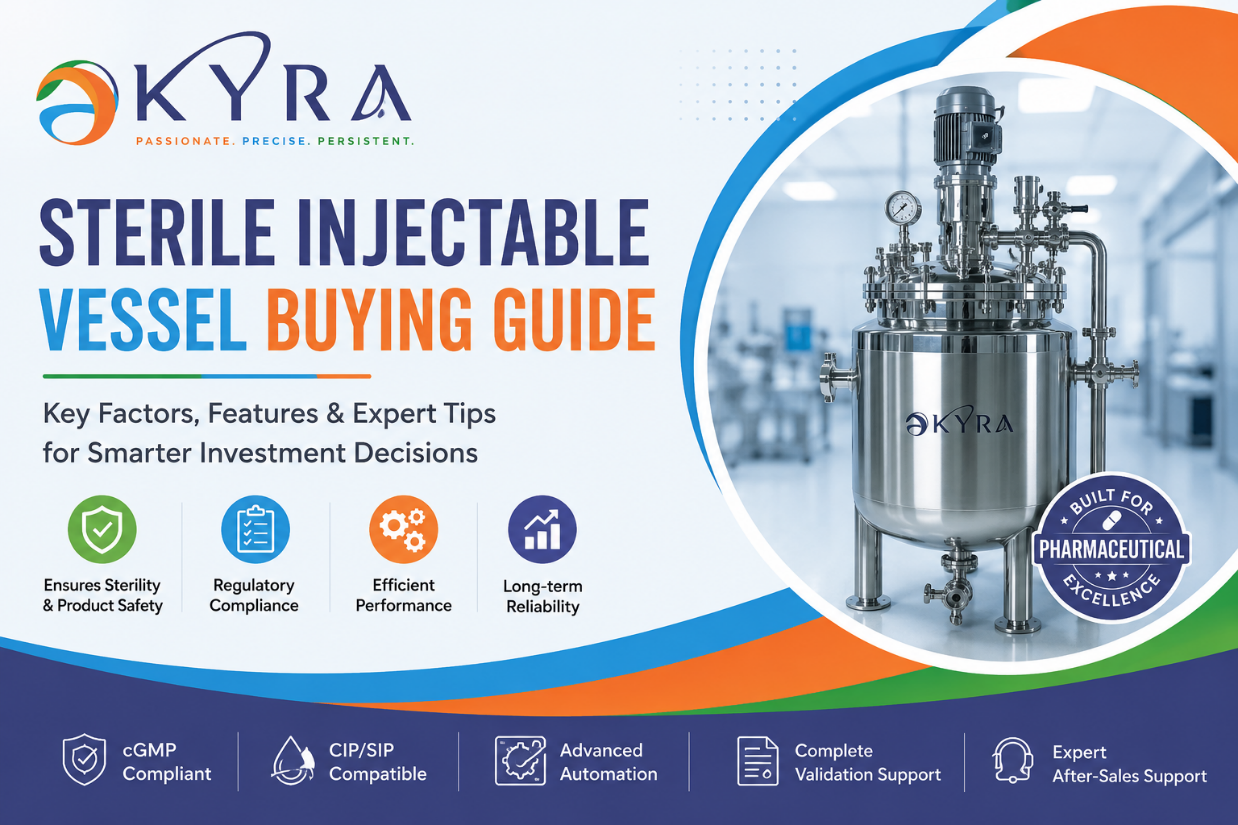
A sterile injectable vessel is a pharmaceutical-grade processing skid specifically designed to manufacture sterile drug formulations under controlled hygienic conditions.
Other conventional mixing tanks, sterile injectable vessels are designed to:
- Maintain hygienic processing conditions
- Prevent microbial contamination
- Support validated manufacturing processes
- Ensure uniform mixing and temperature control
- Meet international pharmaceutical regulations
Key Statement: A sterile filling vessels manufacturer line is only as good as the equipment used in the process.
Industries that commonly require sterile injectable vessels include:
- Pharmaceutical Manufacturing Companies
- Sterile Injectable Drug Manufacturers
- Vaccine Manufacturing Companies
- Biopharmaceutical Companies
- Biotechnology Companies
- CDMOs & CMOs
- Injectable Formulation Manufacturers
- API Processing Plants
- Healthcare Product Manufacturers
- Life Sciences Manufacturing Facilities
What factors should you consider before buying a sterile injectable vessel?
1. Material of Construction (MOC)
The construction material determines hygiene, corrosion resistance, strength, and cleanability.
The preferred materials include:
| Material | Recommended Application |
|---|---|
| SS304 | Utility sections |
| SS316 | Pharmaceutical processing |
| SS316L | Sterile injectable production (preferred) |
SS316L stainless steel offers:
- Excellent corrosion resistance
- Smooth surface finish
- Better chemical compatibility
- Lower microbial adhesion
- Longer service life
Many regulated pharmaceutical facilities also specify electropolished internal surfaces to reduce impurity risks.
2. Does the vessel follow with pharmaceutical standards?
One of the first questions buyers should ask is:
Is the vessel designed according to global pharmaceutical standards?
Look for equipment designed in agreement with:
- US FDA Guidelines
- cGMP Requirements
- WHO Guidelines
- ASME BPE Guidelines
- PED (where applicable)
Compliance simplifies validation and helps manufacturers prepare for regulatory inspections.
Key Statement: Regulatory-compliant equipment reduces validation complexity and improves manufacturing readiness.
3. Is the vessel suitable with CIP and SIP systems?
Sterility depends heavily on cleaning and sterilization.
Modern sterile injectable vessels should support:
- Clean-in-Place (CIP): Automated internal cleaning without disassembling equipment.
- Sterilize-in-Place (SIP): Steam sterilization performed inside the closed vessel before production.
Benefits include:
- Reduced contamination risk
- Faster batch changeovers
- Lower manual involvement
- Improved process repeatability
- Better regulatory compliance
CIP/SIP-ready vessels are now considered standard for sterile pharmaceutical manufacturing.
Which mixing system is best for injectable manufacturing?
The ideal mixing system depends on product characteristics. Common options include:
Standard Mechanical Stirrer
Suitable for:
- General semi solid formulations
- Liquid mixing
- Medium viscosity products
Magnetic Stirrer
Preferred for:
- Highly sterile applications
- Sensitive biologics
- Vaccine manufacturing
- Products requiring minimal pollution risk
Magnetic drive systems remove shaft seals, reducing potential contamination points.
What vessel capacity should you choose?
Capacity depends on production volume.
Typical ranges include:
| Manufacturing Scale | Recommended Capacity |
|---|---|
| Laboratory | 5–20 Litres |
| Pilot Plant | 20–100 Litres |
| Commercial Production | 200–5000 Litres |
Choosing oversized equipment can increase utility costs, while undersized vessels may limit production efficiency. Kyra International manufactures sterile injectable vessels from 5 litres to 5000 litres, supporting both pilot-scale and commercial pharmaceutical production.
Which features improve pharmaceutical manufacturing efficiency?
Look for vessels provided with:
1. Process Automation
- PLC-controlled operation
- Touchscreen HMI
- Recipe management
- Data logging / Data Backup
- 21 CFR Part 11 compatibility
2. Temperature Control
- Steam heating
- Electrical heating
- Cooling jacket
- Mineral wool insulation
3. Process Monitoring
- Load cells
- Level indicators
- Variable Frequency Drive (VFD)
- Pressure monitoring
4. Hygienic Design
- Sanitary bottom valve
- Zero hold-up outlet
- Sterile sampling ports
- Electropolished surfaces
- Sterile air filters
These features improve batch consistency while reducing operator involvement.
What validation documents should the supplier provide?
Documentation is as important as equipment.
A reputable manufacturer should provide:
- Design Qualification (DQ)
- Installation Qualification (IQ)
- Operational Qualification (OQ)
- Performance Qualification (PQ)
- Factory Acceptance Test (FAT)
- Material Test Certificates (MTC)
These documents simplify equipment qualification within regulated pharmaceutical facilities.
Key Statement: Complete validation documents help reduce the time needed to set up pharmaceutical manufacturing equipment.
How do you evaluate the quality of a sterile injectable vessel manufacturer?
Before purchasing, estimate the supplier using this checklist:
- Pharmaceutical process expertise
- Custom engineering capabilities
- GMP-compliant manufacturing
- International project experience
- Technical support
- Spare parts availability
- Installation guidance
- Validation support
- After-sales service
An experienced manufacturer understands not only vessel fabrication but also pharmaceutical process requirements.
Why choose Kyra International for sterile injectable vessels?
We are a Mumbai, India-based manufacturer, supplier, and exporter specializing in pharmaceutical and biopharmaceutical process equipment. The company sterile cream manufacturing, blending vessels, liquid oral processing plants, integrated process skids, and other pharmaceutical processing solutions for healthcare, biotech, and cosmetic industries.
Key advantages include:
- Sterile injectable vessels from 5–5000 litres
- SS304, SS316 & SS316L construction
- FDA, WHO, cGMP & ASME-BPE-oriented designs
- CIP & SIP compatible systems
- PLC-controlled automation
- Mechanical and magnetic stirrer options
- Electropolished contact surfaces
- Zero hold-up sanitary outlet valves
- DQ, IQ, OQ, PQ & FAT documentation
- Custom-engineered solutions for specific production requirements
Kyra International also supports pharmaceutical manufacturers with customized engineering solutions designed to integrate seamlessly into existing production facilities while maintaining regulatory compliance.