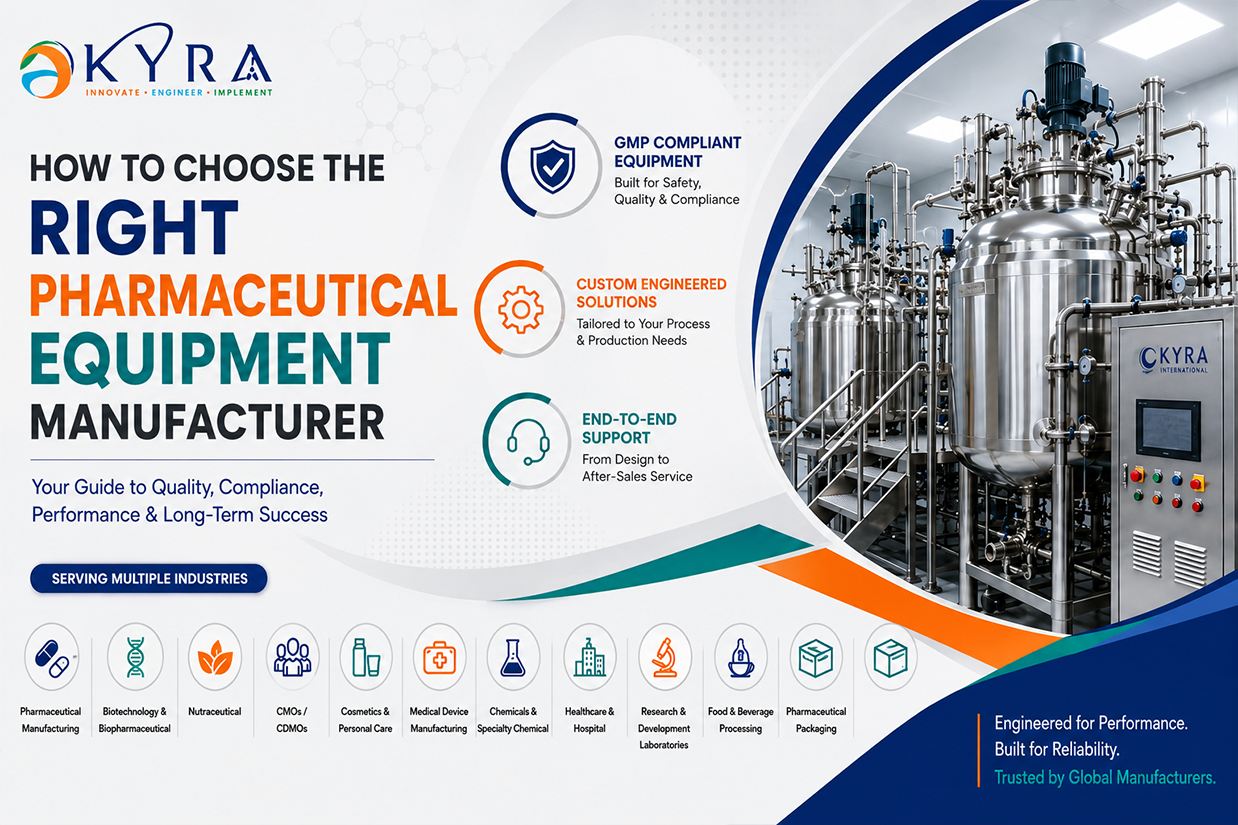
Choosing the right pharmaceutical equipment manufacturer means selecting a partner that delivers GMP-compliant, validated, and customizable process equipment supported by engineering expertise, quality certifications, technical support, and long-term service. The right manufacturer improves product quality, regulatory compliance, production efficiency, and return on investment across pharmaceutical, biotechnology, nutraceutical, and healthcare manufacturing.
Whether you manufacture tablets, injectables, syrups, creams, biologics, cosmetics, medical devices, or food products, your production equipment directly impacts quality, consistency, and operational efficiency. This guide explains the key factors to evaluate before selecting a pharmaceutical equipment manufacturer and why partnering with an experienced engineering company like Kyra International, Mumbai, India, can support long-term manufacturing success.
What is a Pharmaceutical Equipment Manufacturer?
A pharmaceutical equipment manufacturer designs, engineers, manufactures, tests, and supplies process equipment used for producing pharmaceutical, biotechnology, nutraceutical, cosmetic, healthcare, and speciality chemical products.
These manufacturers typically provide:
- Sterile Injectable Vessels
- Liquid Oral/Syrup/Suspension Processing Plants
- Ointment & Cream Manufacturing Plants
- Blending/Reactor Vessels
- Integrated Process Skids
- CIP/SIP Systems
- Mixing & Homogenizing Systems
- Custom Process Equipment
These systems help manufacturers achieve safe, repeatable, validated, and contamination-free production while complying with global quality standards.
Why Does Choosing the Right Equipment Manufacturer Matter?
Choosing equipment only by price can increase costs in the long run.
A safe manufacturer provides:
- Consistent product quality
- Regulatory compliance (GMP, WHO, FDA-ready design)
- Reduced downtime
- Faster batch processing
- Better automation
- Lower maintenance costs
- Long equipment life
- Reliable technical support
A pharmaceutical manufacturing system should be viewed as a long-term production investment rather than a short-term purchase.
What Should You Look for in a Pharmaceutical Equipment Manufacturer?
1. Does the Manufacturer Have Industry Experience?
Experience matters because pharmaceutical manufacturing requires specialized engineering.
Choose manufacturers serving industries such as:
- Pharmaceutical Manufacturing
- Biotechnology
- Biopharmaceutical
- Nutraceutical
- Contract Manufacturing Organizations (CMOs/CDMOs)
- Medical Device Manufacturing
- Cosmetics & Personal Care
- Chemical & Speciality Chemical
- Healthcare & Hospital Manufacturing
- Research & Development Laboratories
- Food & Beverage Processing
- Pharmaceutical Packaging
A manufacturer experienced across multiple sectors understands varying production requirements and validation expectations.
2. Are the Equipment Designs GMP and International Standard-Ready?
Equipment should support compliance with:
| Standard | Why It Matters |
|---|---|
| GMP | Consistent product quality |
| WHO Guidelines | International pharmaceutical manufacturing |
| FDA Design Practices | Regulatory readiness |
| Hygienic Design | Prevents contamination |
| Validation Support | Easier qualification processes |
Proper surface finish, hygienic piping, dead-leg-free designs, and documentation reduce validation complexity.
3. Does the Manufacturer Offer Custom Engineering?
Every manufacturing facility is different.
- Custom vessel sizes
- Process optimization
- Plant layout planning
- Automation integration
- PLC/SCADA systems
- Future production scalability
Custom-engineered systems improve productivity while minimizing space and operating costs.
4. What Materials and Manufacturing Quality Are Used?
High-quality pharmaceutical equipment commonly includes:
- SS304 & SS316L stainless steel
- Accurate welding
- Mirror & Matt surface finishing
- Hygienic fittings
- Factory Acceptance Testing (FAT)
- Complete quality inspection
Equipment quality directly influences product purity, cleaning efficiency, and operational lifespan.
5. Does the Manufacturer Provide Complete Process Solutions?
Instead of purchasing equipment from multiple vendors, many companies now prefer integrated process solutions.
An ideal manufacturer offers:
- Process engineering
- Design & documentation
- Manufacturing
- Installation
- Commissioning
- Validation support
- Operator training
- After-sales service
This reduces project delays and improves accountability.
How Important Are Automation and Process Validation?
Modern pharmaceutical manufacturing increasingly depends on automation.
Key automation features include:
- PLC-controlled systems
- HMI touchscreen interfaces
- Recipe management
- Data logging
- Temperature monitoring
- Pressure monitoring
- Batch traceability
Automation improves consistency while supporting regulatory documentation requirements.
How Can You Evaluate a Manufacturer Before Purchasing?
Use this simple evaluation checklist.
| Evaluation Factor | Check Status |
|---|---|
| Industry Experience | Included |
| Engineering Expertise | Included |
| Product Customization | Included |
| Quality Certifications | Included |
| GMP-Compatible Design | Included |
| Automation Capabilities | Included |
| Validation Documentation | Included |
| Installation Support | Included |
| After-Sales Service | Included |
| Spare Parts Availability | Included |
A manufacturer meeting most of these criteria is better positioned to support long-term production success.
Why Do Manufacturers Choose Kyra International?
We are a Mumbai, India-based manufacturer, supplier, and exporter of pharmaceutical and cosmetic process equipment serving healthcare and life science industries.
The company specializes in:
- Sterile Injectable Vessels
- Liquid Oral/Syrup/Suspension Processing Plants
- Blending/Reactor Vessels
- Ointment & Cream Manufacturing Plants
- Integrated Skids
- Process Engineering
- Custom Manufacturing Systems
- SIP/CIP Systems
Kyra International combines process engineering expertise, customized equipment design, modern manufacturing infrastructure, and quality-focused production to deliver cost-effective solutions for pharmaceutical, biotech, cosmetics, and healthcare manufacturers. Their engineering workflow includes P&ID development, 3D modelling, Factory Acceptance Testing (FAT), and customized system integration to improve operational efficiency and scalability.