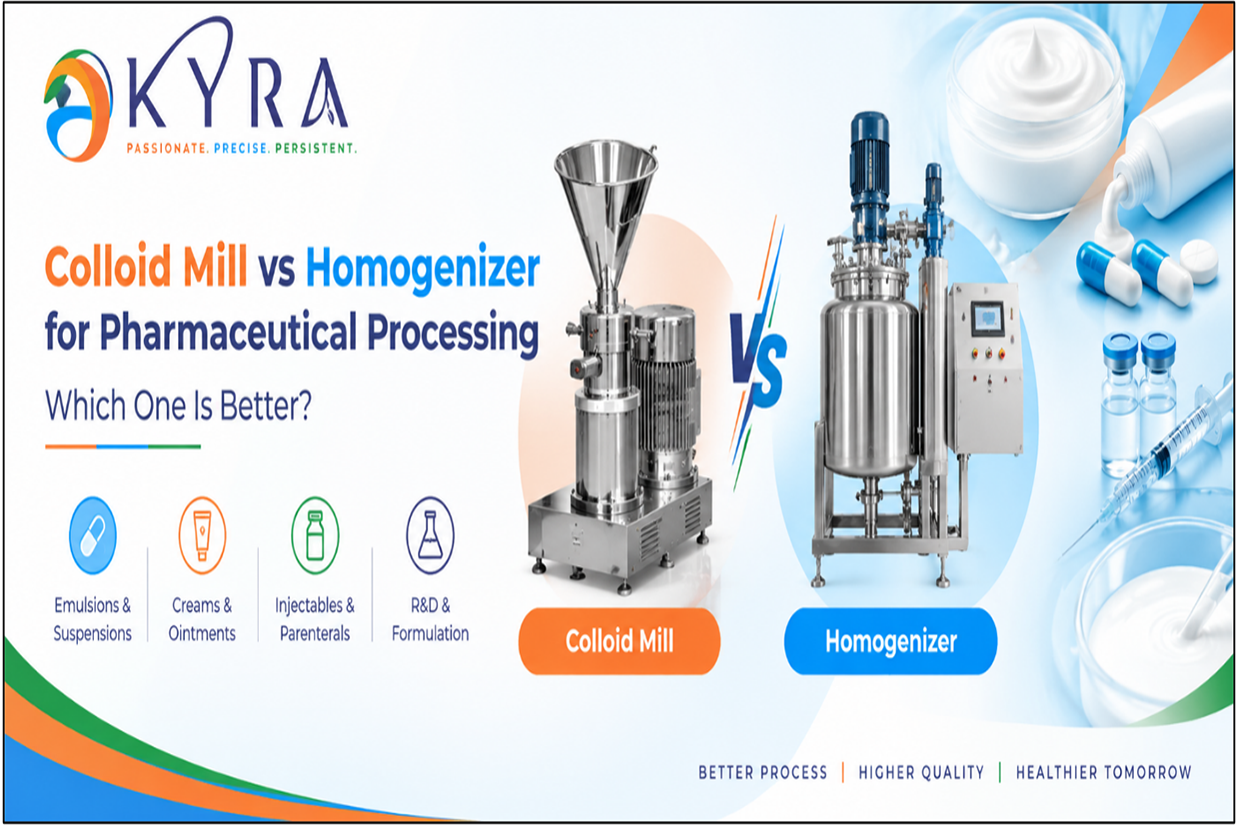
For pharmaceutical processing, neither a colloid mill nor a homogenizer is universally better. A colloid mill is often ideal for viscous creams, ointments, pastes, and continuous emulsification, while a homogenizer provides greater flexibility for fine dispersion, emulsions, suspensions, and formulation development. The right choice depends on viscosity, particle or droplet size, shear requirements, batch size, and process design.
What Is the Difference Between a Colloid Mill and a Homogenizer?
A colloid mill is a high-shear pharmaceutical processing machine that uses a rapidly rotating rotor and stationary stator to generate intense shear and friction. It is commonly used for emulsification, dispersion, agglomerate reduction, and particle-size reduction in liquid and semi-solid products.
A homogenizer is a broader category of processing equipment designed to produce a uniform dispersion by applying mechanical or hydraulic forces. Depending on its design, it may be a rotor-stator homogenizer, inline homogenizer, high-pressure homogenizer, or laboratory homogenizer.
In simple terms, a colloid mill is a specific high-shear machine, while a homogenizer represents a wider range of homogenization technologies.
| Feature | Colloid Mill | Homogenizer |
|---|---|---|
| Main action | Rotor-stator shear | Disintegrated Stator-rotor high shear |
| Best suited for | Viscous products, emulsions, paste | Fine dispersion, emulsions, suspensions |
| Cream & ointment processing | Excellent | Excellent with suitable design |
| Particle reduction | Yes | Yes |
| Continuous processing | Suitable | Suitable with inline systems |
| R&D flexibility | Good | Very good |
| Typical Kyra power range | 1 – 10 HP | 0.5 – 50 HP |
Kyra International lists colloidal mills in a 1 - 10 HP range and homogenizer/mechanical-stirrer systems in a 0.5 – 50 HP range. Actual equipment selection should be based on formulation and process requirements rather than motor power alone.
How Does a Colloid Mill Work in Pharmaceutical Manufacturing?
A colloid mill forces the product through a narrow gap between a rotating rotor and stationary stator. The resulting shear, friction, and mechanical forces help break agglomerates and improve dispersion and emulsification.
Kyra International's published colloidal mill information describes operation at approximately 2,800 ~ 3,000 rpm, with adjustable rotor-stator clearance and recirculation capability on suitable configurations.
Colloid mills are particularly useful for:
- Ointment manufacturing
- Cream manufacturing
- Gel and Paste production
- Pharmaceutical emulsions
- Cosmetic and cosmeceutical formulations
- High-viscosity pastes
- Selected pharmaceutical suspensions
How Does a Homogenizer Work in Pharmaceutical Processing?
A rotor-stator homogenizer produces high shear between rotating and stationary components.
Homogenizers can support:
- Fine emulsification
- Suspension processing
- Particle dispersion
- Droplet-size reduction
- Agglomerate breakup
- Cream and lotion manufacturing
- Pharmaceutical R&D
- Nutraceutical and cosmetic processing
Kyra International lists homogenizer and mechanical-stirrer systems with variable-speed operation and power options ranging from 0.5 to 50 HP, depending on configuration and application.
Which Is Better for Cream and Ointment Manufacturing?
For high-viscosity creams and ointments, a colloid mill can be an excellent choice, particularly where intensive shear, emulsification, dispersion, and recirculation are required.
A homogenizer can be preferable where controlled emulsification and flexible shear conditions are more important.
The decision should consider:
- Product viscosity
- Oil and water phases
- Desired droplet size
- Solid content
- Temperature sensitivity
- Required batch size
- Processing time
- Recirculation requirements
- Cleaning and validation requirements
Kyra International's cream, gel and lotion manufacturing plants combine manufacturing vessels, high-speed homogenization, slow-speed agitation, heating/cooling, vacuum processing and automation. Its published plant capacities range from 5 to 10,000 kg.
For cream manufacturing, the best solution is often an integrated process system rather than a standalone homogenizer or mill.
Which Is Better for Pharmaceutical Suspensions and Emulsions?
Both machines can be suitable for pharmaceutical suspensions and emulsions, but the choice depends on the formulation's required particle or droplet-size distribution.
A homogenizer may be preferred when fine dispersion and controlled droplet-size reduction are critical. A colloid mill can be highly effective when intensive rotor-stator shear and viscous-product processing are required.
Important product-quality considerations include:
- Particle-size distribution
- Droplet-size distribution
- Viscosity
- Sedimentation
- Redispersibility
- Physical stability
- Content uniformity
- Appearance
EMA guidance identifies particle size and homogeneity/redispersibility as important considerations for liquid pharmaceutical preparations such as suspensions and emulsions.
The better machine is the one that consistently delivers the required critical quality attributes at commercial scale.
Can These Machines Be Used for Oral, Injectable, and Biopharmaceutical Products?
Yes, but application requirements differ considerably.
For oral drug formulations, colloid mills and homogenizers may support suspensions, emulsions and other dispersed systems. Kyra International lists liquid oral processing plants with capacities from 50 to 15,000 litres.
For injectable and parenteral manufacturing, equipment must meet much stricter hygienic, contamination-control and sterilization requirements. A homogenizer or colloid mill does not make a product sterile by itself.
For biopharmaceutical manufacturing, excessive shear, heat, air incorporation, or processing time can affect sensitive biological materials. Equipment must therefore be selected through formulation-specific development studies.
WHO GMP and FDA process-validation principles emphasize controlled, reproducible and scientifically understood manufacturing processes.
How Should Pharmaceutical Manufacturers Choose Between a Colloid Mill and Homogenizer?
A practical selection framework is:
Choose a colloid mill when:
- The product is relatively viscous.
- Intensive rotor-stator shear is required.
- Emulsification is a major process objective.
- Agglomerate reduction is important.
- Continuous or recirculation processing is desirable.
- Cream, ointment, paste, or similar semi-solid products are being processed.
Choose a homogenizer when:
- Fine dispersion is required.
- Droplet-size reduction is critical.
- Pharmaceutical suspensions or emulsions are being developed.
- Flexible shear control is required.
- R&D-to-production scalability is important.
- Inline processing is preferred.
Consider both when:
A formulation requires bulk mixing plus intensive high-shear processing. An integrated system can use an agitator for bulk circulation, a homogenizer for dispersion, and a colloid mill for additional high-shear processing.
What Specifications Should Be Compared Before Buying?
Pharmaceutical manufacturers should compare more than price and horsepower.
Important specifications include:
- Motor power
- Rotor speed
- Rotor-stator design
- Adjustable working gap
- Flow rate
- Product viscosity range
- Product-contact material
- SS 316/316L construction
- Seal design
- Temperature range
- Pressure capability
- Batch capacity
- Recirculation capability
- CIP/SIP compatibility
- PLC/HMI automation
- Cleaning and validation documentation
RPM and horsepower alone cannot guarantee particle size, droplet size, emulsion stability, or product uniformity.
ICH Q8 recommends developing an understanding of how material attributes and process parameters influence pharmaceutical product quality.
What Are the Latest Trends in Pharmaceutical Homogenization?
Modern pharmaceutical and biopharmaceutical manufacturing is increasingly focused on:
- Process understanding
- Automated control
- Process Analytical Technology (PAT)
- Continuous manufacturing
- Data-driven process monitoring
- Flexible CMO/CDMO equipment
- Scale-up and technology transfer
- Improved cleaning and validation
- Energy-efficient processing
FDA's PAT framework and ICH Q13 on continuous manufacturing reflect the industry's movement toward more controlled and measurable manufacturing processes.
For pharmaceutical R&D, generic drug manufacturing, nutraceutical production, veterinary pharmaceuticals, cosmetics, biotechnology, and CMO/CDMO operations, equipment flexibility and process repeatability are becoming increasingly important.
Why Choose Kyra International for Pharmaceutical Processing Equipment?
Kyra International is a manufacturer, supplier, and exporter of pharmaceutical processing equipment based in Mumbai, India. Its portfolio includes colloidal mills, homogenizers and mechanical stirrers, sterile injectable vessels, liquid oral processing plants, cream/gel/lotion manufacturing plants, ointment manufacturing systems, blending vessels, and CIP/SIP systems.
The company serves pharmaceutical, biopharmaceutical, biotechnology, cosmetic, nutraceutical and related manufacturing industries.
Kyra's approach focuses on selecting equipment according to the application rather than treating every formulation with the same machine. Its equipment and integrated plant solutions can be configured around processing, heating/cooling, homogenization, agitation, vacuum, transfer, automation, cleaning and validation requirements.
For manufacturers evaluating colloid mills, homogenizers, ointment manufacturing plants, cream manufacturing plants, liquid pharmaceutical processing systems, or customized pharmaceutical machinery, Kyra International can help determine an appropriate equipment configuration based on the formulation and production requirements.
Frequently Asked Questions
Final Verdict: Colloid Mill or Homogenizer?
A colloid mill is generally the stronger choice for viscous creams, ointments, pastes, and intensive rotor-stator processing, while a homogenizer is generally more versatile for fine dispersion, emulsification, suspensions, and formulation development.
For advanced pharmaceutical manufacturing, the best answer may not be “colloid mill versus homogenizer.” It may be colloid mill plus homogenizer plus a properly engineered manufacturing vessel and process-control system.
The final selection should be based on viscosity, particle/droplet size, shear sensitivity, batch volume, processing mode, cleaning requirements, validation needs, and scale-up performance.