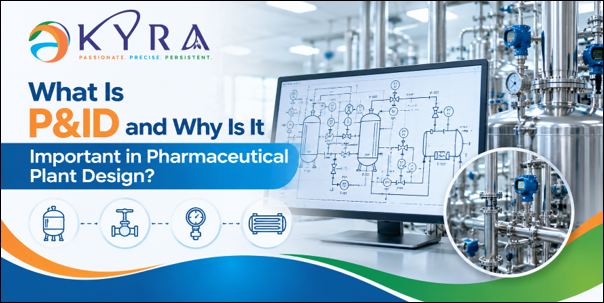
A P&ID (Piping and Instrumentation Diagram) is a detailed engineering drawing that shows how process equipment, piping, valves, instruments, utilities, and control systems are connected and operate together. In pharmaceutical plant design, a P&ID helps engineers define process flow, instrumentation, automation, cleaning, safety, utility connections, and equipment interfaces before installation and commissioning.
What Does P&ID Mean in Pharmaceutical Engineering?
P&ID stands for Piping and Instrumentation Diagram. It is a detailed engineering document used to represent the functional relationship between process equipment, piping, valves, instruments, and control systems.
A pharmaceutical P&ID can include manufacturing vessels, pumps, filters, heat exchangers, transfer lines, control valves, temperature and pressure instruments, purified water, WFI, clean steam, compressed air, nitrogen, vacuum, heating and cooling systems.
A P&ID is not simply a drawing of pipes; it is a functional map showing how a process is connected, measured, controlled, cleaned, and operated.
The International Society of Automation (ISA) provides standardized approaches for instrumentation and control symbols and identification through ANSI/ISA-5.1. This helps different engineering disciplines interpret instrumentation and control documentation consistently.
Why Is P&ID Important in Pharmaceutical Plant Design?
A P&ID converts a process concept into a detailed engineering representation that can be understood by process, mechanical, piping, instrumentation, automation, validation, production, and maintenance teams.
In pharmaceutical manufacturing, a P&ID helps engineers review:
- Process equipment and connections
- Product transfer pathways
- Piping and valves
- Instrumentation and control loops
- Pharmaceutical utility connections
- CIP and SIP arrangements
- Drain and vent connections
- Safety and isolation provisions
- Automation requirements
- Commissioning and qualification requirements
FDA guidance highlights that pharmaceutical manufacturing equipment should be appropriately designed, sized, constructed, installed, and maintained for its intended use, including cleaning and maintenance requirements.
A well-developed P&ID provides a common technical reference for translating pharmaceutical process requirements into an engineered plant system.
What Information Is Shown on a Pharmaceutical P&ID?
A pharmaceutical P&ID normally combines several categories of engineering information.
Process Equipment
Equipment may include:
- Manufacturing and blending vessels
- Storage and holding vessels
- Sterile injectable vessels
- Pumps
- Filters
- Heat exchangers
- Reactors
- Homogenizers
- Transfer systems
Each item is normally identified using an equipment tag so it can be consistently referenced across engineering drawings, specifications, commissioning documents, and maintenance records.
Piping and Valves
P&IDs identify process and utility piping, flow direction, line identification, valves, isolation points, drains, vents, and other important connections.
Valve arrangements may include isolation valves, check valves, control valves, diaphragm valves, sampling valves, drain valves, and other process-specific configurations.
Instrumentation and Control
Typical pharmaceutical process instruments measure:
| Instrument | Typical Function |
|---|---|
| Temperature transmitter | Measures process temperature |
| Pressure transmitter | Measures process pressure |
| Flow transmitter | Measures fluid flow |
| Level transmitter | Measures vessel level |
| pH instrument | Monitors pH |
| Conductivity instrument | Monitors conductivity |
| Differential pressure transmitter | Measures pressure difference |
| Control valve | Regulates process flow |
The exact instrumentation depends on the process, equipment, control philosophy, quality requirements, and project specifications.
How Is a P&ID Different From a PFD?
A PFD (Process Flow Diagram) provides a high-level representation of a manufacturing process, while a P&ID provides detailed information about piping, valves, instrumentation, and control functions.
| Feature | PFD | P&ID |
|---|---|---|
| Process overview | Yes | Yes |
| Major equipment | Yes | Yes |
| Detailed piping | Limited | Yes |
| Valves | Limited | Detailed |
| Instrumentation | Limited | Detailed |
| Control loops | Limited | Detailed |
| Utility connections | High-level | Detailed |
| Maintenance reference | Limited | Useful |
| Commissioning reference | Limited | Important |
In simple terms, a PFD explains what happens in a process, while a P&ID explains how the process is connected, measured, and controlled.
How Does P&ID Support Pharmaceutical GMP Requirements?
A P&ID does not make a pharmaceutical facility GMP compliant by itself. Instead, it is one of the engineering documents used to design and review systems against applicable process, quality, safety, and regulatory requirements.
For pharmaceutical equipment, engineers can use the P&ID to review:
- Product-contact pathways
- Equipment connections
- Cleaning and sanitation routes
- Utility connections
- Process segregation
- Instrumentation
- Drainage
- Sampling points
- Isolation arrangements
- Automation interfaces
For API manufacturing, FDA's ICH Q7 guidance states that equipment should be appropriately designed, sufficiently sized, suitably located, and suitable for cleaning, sanitation, and maintenance.
The P&ID should therefore reflect the intended process and engineering requirements rather than being treated as documentation created only after equipment installation.
Why Is P&ID Important for CIP and SIP Systems?
CIP means Cleaning-In-Place, while SIP means Sterilization-In-Place.
CIP allows suitable process equipment and systems to be cleaned without conventional dismantling. SIP is used for sterilization of applicable process systems, commonly through steam-based methods.
A P&ID can help engineers evaluate:
- CIP supply and return paths
- Cleaning solution circulation
- Spray-device connections
- Drainage
- Steam connections
- Condensate removal
- Temperature and pressure monitoring
- Isolation valves
- Flow measurement
FDA requirements emphasize appropriate cleaning, maintenance, and, where applicable, sanitization or sterilization of pharmaceutical equipment.
A useful pharmaceutical P&ID review question is: “Can every intended product-contact pathway be cleaned, drained, isolated, and controlled according to the process requirement?”
How Does P&ID Support Pharmaceutical Water Systems?
Pharmaceutical water systems may supply water for manufacturing, cleaning, formulation, equipment operation, or other controlled applications.
A P&ID can document:
- Water generation
- Storage
- Distribution
- Recirculation
- Pumps
- Heat exchangers
- Sanitization
- Sampling points
- Flow paths
- Drain points
- Temperature monitoring
- Pressure monitoring
WHO guidance states that pharmaceutical water systems should be appropriately designed, installed, commissioned, qualified, operated, and maintained to reliably produce water of the required quality.
This makes P&IDs particularly important for systems involving Purified Water, Water for Injection (WFI), pharmaceutical water distribution, and associated utilities.
How Does P&ID Support Pharmaceutical Process Automation?
Modern pharmaceutical plants increasingly use automation to monitor process parameters, control equipment, manage alarms, record data, and improve process repeatability.
A P&ID provides an important link between process engineering and automation engineering.
For example:
- Temperature sensor → transmitter → controller → control valve → heating/cooling medium
- Level transmitter → level controller → process control function
This information helps automation engineers understand which variables must be measured and controlled.
ISA's instrumentation standards provide a consistent framework for representing measurement and control functions.
A pharmaceutical P&ID provides important engineering inputs for PLC, SCADA, DCS, and other industrial automation systems.
What Should Engineers Check During a Pharmaceutical P&ID Review?
A multidisciplinary P&ID review should consider more than basic pipe connections.
Process Review
Check:
- Correct process sequence
- Equipment connections
- Flow direction
- Product transfer routes
- Batch requirements
- Process conditions
Hygienic Design Review
Check:
- Product-contact pathways
- Drainability
- Cleanability
- Cleaning connections
- Sanitization requirements
- Material compatibility
- Potential contamination risks
Instrumentation Review
Check:
- Temperature
- Pressure
- Flow
- Level
- Control loops
- Alarms
- Instrument locations
- Control-valve functions
Utility Review
Check:
- Purified water
- WFI
- Clean steam
- Compressed air
- Nitrogen
- Vacuum
- Heating
- Cooling
- Drainage
Documentation Review
Check:
- Equipment tags
- Line numbers
- Instrument tags
- Symbols
- Revision number
- Drawing legend
- Approved design changes
Finding a design problem on a P&ID is generally preferable to discovering the same problem after fabrication, installation, or commissioning.
Which Industries Use P&IDs?
P&IDs are useful wherever manufacturing systems involve process equipment, piping, instrumentation, and control.
They are particularly relevant to:
- Pharmaceutical Manufacturing
- Biotechnology
- Life Sciences
- API Manufacturing
- Biopharmaceuticals
- CDMO and CMO Manufacturing
- Pharmaceutical Engineering & EPC
- Chemical Manufacturing
- Medical & Healthcare Equipment
- Nutraceuticals
- Vaccine Manufacturing
- Specialty Chemicals
- Food & Beverage Processing
- Cosmetics & Personal Care
- Industrial Automation & Process Control
Although the equipment and regulatory requirements differ between industries, the fundamental purpose remains similar: to clearly document how process equipment, piping, instrumentation, utilities, and controls work together.
What Is the Role of P&ID in Pharmaceutical Process Equipment?
P&IDs become especially valuable when individual process equipment must integrate with a larger manufacturing system.
For example, a pharmaceutical manufacturing vessel may require:
- Product inlet and outlet
- Agitator
- Temperature measurement
- Level measurement
- Heating/cooling connections
- CIP connections
- Drain
- Vent
- Sampling arrangement
- Transfer piping
- Utility connections
The P&ID helps ensure that equipment requirements are considered as part of the complete process rather than as isolated machinery.
How Does Kyra International Support Pharmaceutical Process Equipment Requirements?
We are a manufacturer, supplier, and exporter of pharmaceutical and process equipment based in Mumbai, India. The company serves pharmaceutical, biotechnology, biopharmaceutical, healthcare, and cosmetic-related applications.
Its product portfolio includes equipment and systems such as:
- Sterile injectable vessels
- Liquid oral processing plants
- Blending vessels
- Ointment and cream manufacturing plants
- Integrated skids and process equipment
For pharmaceutical and allied manufacturing projects, equipment selection should consider the complete process, including capacity, material requirements, product transfer, utilities, instrumentation, automation, cleaning, and installation requirements.
A process equipment manufacturer should therefore be evaluated not only on the individual machine supplied but also on how effectively the equipment can integrate with the overall manufacturing system.
Frequently Asked Questions about P&ID in Pharmaceutical Plant Design
Key Takeaways
A P&ID is the detailed engineering map that connects pharmaceutical process equipment, piping, instrumentation, utilities, and control systems.
The key points are:
- P&ID means Piping and Instrumentation Diagram.
- A P&ID provides more engineering detail than a PFD.
- It identifies equipment, piping, valves, instruments, and control loops.
- It supports pharmaceutical process automation and utility planning.
- It helps engineers evaluate cleaning, drainage, and sanitation pathways.
- It supports commissioning, qualification, maintenance, and troubleshooting.
- It improves communication between multidisciplinary engineering teams.
- It should be developed early and controlled throughout the project lifecycle.
In simple terms, a pharmaceutical P&ID connects the process concept to the physical plant by showing how equipment, piping, instruments, utilities, and controls work together.
Conclusion
Kyra International is a Mumbai-based manufacturer, supplier, and exporter of pharmaceutical and process equipment. The company serves pharmaceutical, biotechnology, biopharmaceutical, healthcare, and cosmetic industries with process equipment and systems designed around manufacturing requirements.
For pharmaceutical plant projects, Kyra International's equipment portfolio can be considered for applications involving pharmaceutical manufacturing vessels, sterile injectable processing, liquid oral manufacturing, blending, ointment and cream production, and integrated process systems.
Planning a pharmaceutical, biotech, cosmetic, nutraceutical, or allied process manufacturing project? Contact Kyra International to discuss your process, equipment, capacity, utility, instrumentation, and project requirements.